Kakamega The Restoration Process
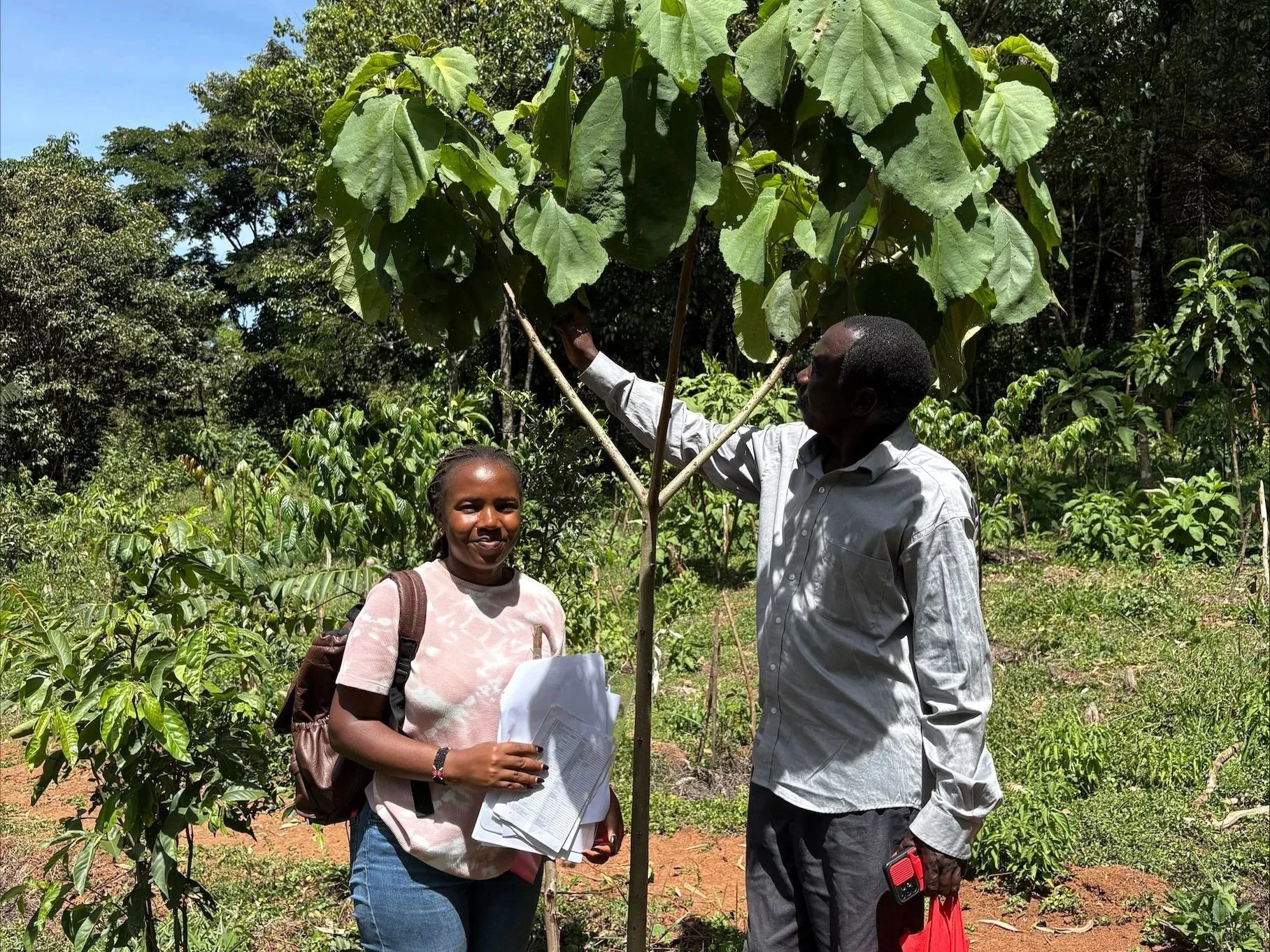
Cheryl with Tree specialist Paul
Our Restoration Process: From Invasion to Regeneration
By Cheryl Achesa
Kakamega Forest restoration, for us, is slow, practical work. It starts with paying attention to what the forest is telling us and staying involved long after the first trees are planted. What follows is the process we use on the ground, shaped by experience, trial and error, and a long-term commitment to seeing these sites recover.
1. Starting Point: Guava-Dominated Forest Areas
[Insert image: Dense guava thicket with sparse forest floor]
Most of our sites begin as dense guava thickets. While guava appears green and healthy from a distance, the reality underneath is very different. The forest floor is often bare, with almost no young indigenous trees coming up. Compared to a natural forest—where seedlings, shrubs, and mature trees exist together— these areas show very little regeneration. Identifying such patches helps us focus our efforts where intervention is genuinely needed.
2. Mapping and Marking the Site
Before any clearing starts, we map out the specific area to be restored. This helps us work within clear boundaries and avoid unnecessary disturbance to the surrounding forest. It also allows us to plan planting density, fencing, and follow-up visits. Taking time at this stage saves mistakes later on.
3. Manual Guava Clearance
[Insert image: Men clearing guava using pangas]
We remove guava by hand using pangas. This method is labour-intensive, but it allows careful, selective clearing. Any indigenous seedlings already present are protected, and the soil is left largely undisturbed. Avoiding heavy machinery helps preserve soil structure and any remaining natural seed bank. This stage also provides local employment, linking restoration work directly to community livelihoods.
4. Fencing the Site Using Cleared Guava
[Insert image: Fence made from guava branches/ Women carrying bundles of firewood]
Instead of discarding the cleared guava, we use it to build a fence around the site. This fence is essential. Cattle can trample young seedlings and spread guava seeds through their dung, quickly reversing restoration gains. By keeping livestock out, we reduce reinvasion and give planted trees a chance to establish. Using guava as fencing material is a simple, effective way of turning the problem into part of the solution. Dry guava is also carried by women from the community to be used as a source of income as well as firewood therefore enabling livelihoods while easing pressure on the forest.
5. Pitting for Tree Planting
Once the site is secure, we dig planting holes across the area. Proper pitting improves water retention and allows roots to establish more easily. Although it is not the most visible stage of restoration, it plays a major role in seedling survival, especially during dry periods.
6. Species Selection and Procurement
[Insert image: Indigenous seedlings ready for planting]
We select indigenous tree species that naturally belong to the Kakamega forest. Species choice is guided by site conditions such as soil, elevation (1500-1600m), and existing vegetation. Our aim is to restore forest structure and function, not just increase tree numbers. This includes a mix of canopy trees and understory species that support wildlife and soil health. Seedlings are bought from the community nurseries as an economic empowerment initiative.
7. Collection of Wildings
[Insert image: Collection of wildings]
In addition to nursery seedlings, we collect wildings from nearby forest areas where young trees are overcrowded or unlikely to survive. These seedlings are already adapted to local conditions and often establish more successfully after transplanting. Collecting wildings also helps maintain local genetic diversity.
8. Tree Planting
Tree planting is done during the onset of the rainy season (April) to allow a minimum of 6 months of continuous rainfall for higher survival chances. This also reduces the costs of watering seedlings. Each seedling is planted at the correct depth and spacing to reduce competition and improve survival. Community members are actively involved in this stage, helping build shared responsibility for the site and its future.
9. Staking Young Seedlings
Newly planted seedlings are supported with stakes to protect them from accidental damage by cattle. This simple step helps young trees grow straight and reduces early losses during the establishment phase.
10. Maintenance and Follow-Up
[Insert image: Ongoing maintenance work—repairing fence or weeding]
Maintenance is the most important part of our work. We return regularly to repair fences, remove weeds, and replace seedlings that fail to survive. This continues until trees reach at least one metre in height and are strong enough to compete on their own. Many projects end at planting; our work continues well beyond that point, resulting in much higher survival rates.
11. Tagging, Monitoring, and Growth Measurement
To track progress over time, we tag at least one seedling from each planted species. Each tagged tree is assigned a unique number and its GPS coordinates are recorded. This allows us to locate the same tree during future visits.